


In light of my current obsession with Heated Rivalry (the books, the show, the fandom), I’ve been curious (yes, that’s an Ilya reference, IYKYK) what data I could find or gather about the rise of queer romance books.
In 2023, Circana reported that the sales of LGBTQ fiction in the U.S. reached an all-time high in the 12 months ending May 2023, selling 6.1 million units—an 11% increase over the previous 12-month period and a 173% surge compared to the pre-pandemic benchmark of 2019.
The report notes that adult romance is the genre that’s experienced the most significant gains when it comes to LGBTQ fiction:
“Sales of LGBTQ romance novels reached 1 million units in the 12 months ending May 2023, exhibiting a remarkable 40% increase over the corresponding period last year. Notably, romance contributes to 30% of the overall growth witnessed in LGBTQ subjects.”
– Soaring Sales of LGBTQ Fiction Defy Book Bans and Showcase Diversity in Storytelling, Circana (June 6, 2023)
I decided to see what other data I could find from the the following three sources:
Google Trends
Amazon Kindle Store
romance.io Website
1. Google Trends
Helpfully, there is an LGBTQ romance topic established on Google Trends, but it only has data back to 2022 and isn’t specific to romance books. However, it does give us an overall sense of interest in this topic (see chart below).
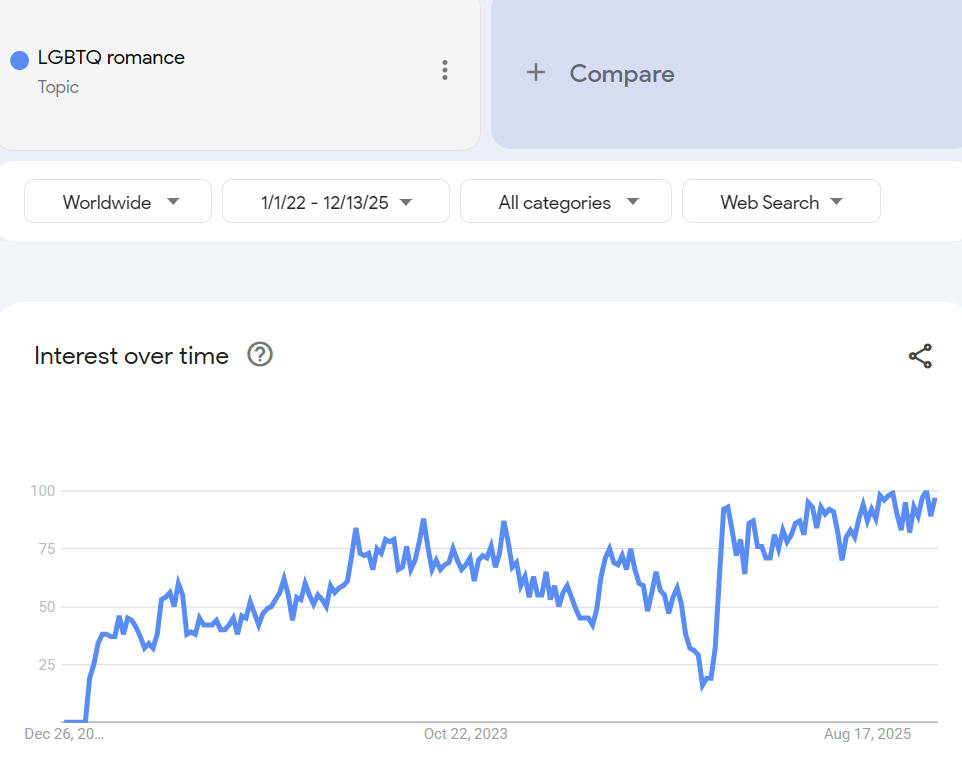
Is anyone surprised to see that the biggest drop in this topic was the week of November 17-23, 2024? As a reminder, that was roughly 2 weeks after the most recent presidential election in the United States.
However, the popularity of the topic bounced back fairly quickly and has generally been trending upwards (with peaks and valleys along the way).
2. Amazon Kindle Store
Using the Kindle Store Power Search tool (powered by Kindletrends), I took a look at the number of books published in the Romance LGBTQ+ category going back to 2012.
Romance LGBTQ+ Category
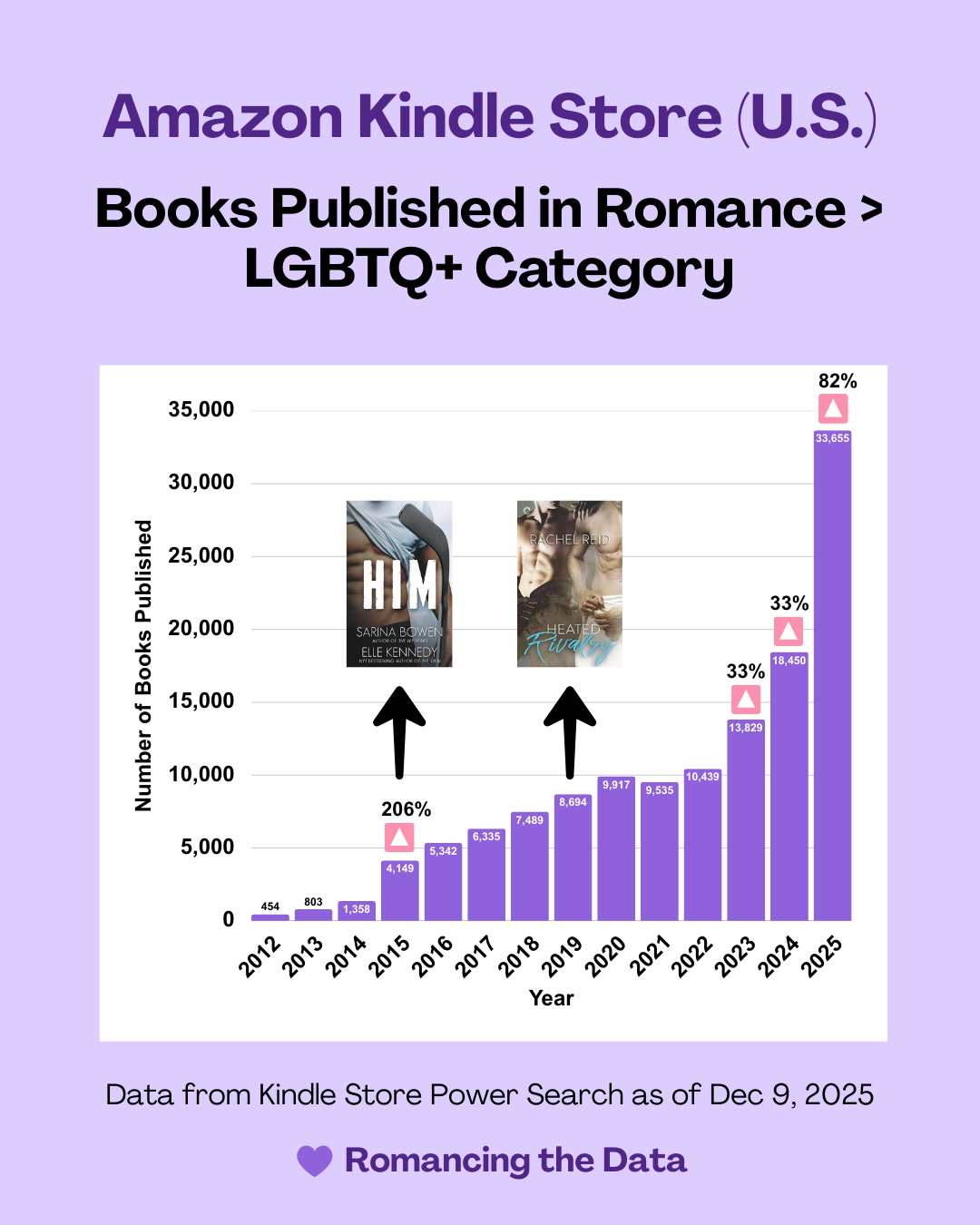
Looking at the bar chart below, we see the first year of significant growth is 2015, with an increase of 206% in the Romance LGBTQ+ category (from 1,358 to 4,149 books published).
That year Publishers Weekly released an article that cited a shift in publishing:
“As same-sex unions continue to gain acceptance across the U.S.—at press time, 37 states and Washington, D.C., have legalized same-sex marriage1—a shift is taking place in publishing, too, and books featuring LGBTQ characters are earning recognition in the traditional romance world.”
– Michael M. Jones, “Finding Love In All the Right Places: Romance 2015”, Publishers Weekly (June 5, 2015)
2015 is also the year the popular gay hockey romance Him by Sarina Bowen and Elle Kennedy was published. (Heated Rivalry by Rachel Reid was published a few years later in 2019).
From 2015, we see fairly steady growth year over year, with a slight dip in 2021 likely due to the pandemic.
Starting in 2023, however, there’s a pretty significant uptick with two years of 33% growth and 82% growth so far in 2025 (as of December 9, 2025 when the data was collected).
Romance LGBTQ+ Subcategories
We can also break down these results further into the four main subcategories within Romance LGBTQ+:
Gay Romance
Lesbian Romance
Bisexual Romance
Transgender Romance
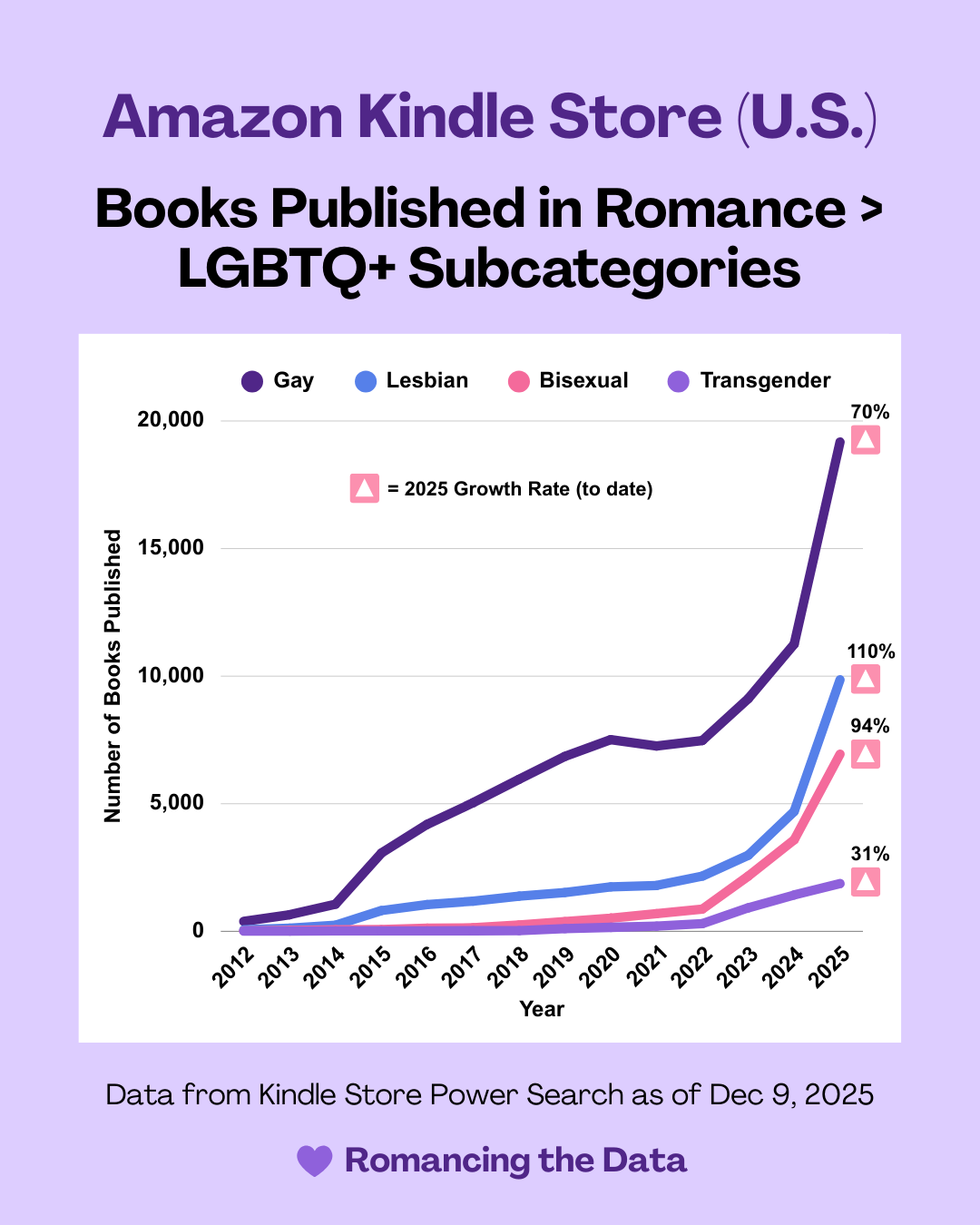
As you see in the line graph below, Gay Romance is the subcategory with the most books, followed by Lesbian, Bisexual, and Transgender. You can see how the growth started escalating around 2022/2023 and has been the most dramatic in 2025, except for in the Transgender subcategory (it’s highest growth year was 2023).
2025 Growth Rate for Romance LGBTQ+ Subcategories:
Lesbian Romance - ⬆110%
Bisexual Romance - ⬆ 94%
Gay Romance - ⬆ 70%
Transgender Romance - ⬆ 31%
As of December 9, 2025
Caveats
I need to point out two caveats here. First, it’s likely that some portion of the more recent growth in this category can be attributed to AI-created books. However, if the growth was mostly AI-driven, I would expect to see a similar growth rate in the Romance category overall. However, there was only a 23% increase in books published in Romance from 2024 to 2025 (as of Dec 9, 2025). As such, I think it’s safe to say that there’s been true growth in the Romance LGBTQ+ category beyond AI-generated content.
Second, this is data gleaned from Amazon’s website and we are trusting that they are displaying accurate information in their public search results. There is also likely some duplication in the results, such as multiple entries per format (ebook, physical, audio), reissues or releases, non-English language titles, etc., but the assumption is that this possible inflation is happening relatively equally across search results.
romance.io
romance.io is the largest romance-only book website and houses a database of 600,000+ romance books. It also features the Romance Book Finder, a fantastic interface that allows users to filter results by a vast array of tags, covering everything from subgenres, tropes, steam level, content warnings and much more.
Using this tool, I was able to compare how many romance books from the past 20 years have been tagged with a relationship on the LGBTQ+ spectrum.
The site uses the following main Relationship tags:
m-f romance (male-female)
gay romance
lesbian romance
queer romance
There is also a non-binary romance tag, but the numbers are so low that it just ended up obscuring the x-axis (for example, only 41 books tagged in 2025).
Please keep in mind, that tags on the romance.io website are user generated, so not all books get tagged or could be tagged inaccurately.
With that in mind, it’s interesting to see that the number of m-f romance tags is much lower than queer or gay romance tags. One potential explanation is that readers may assume m-f romance is the “default” and not feel the need to tag books that feature heterosexual relationships.
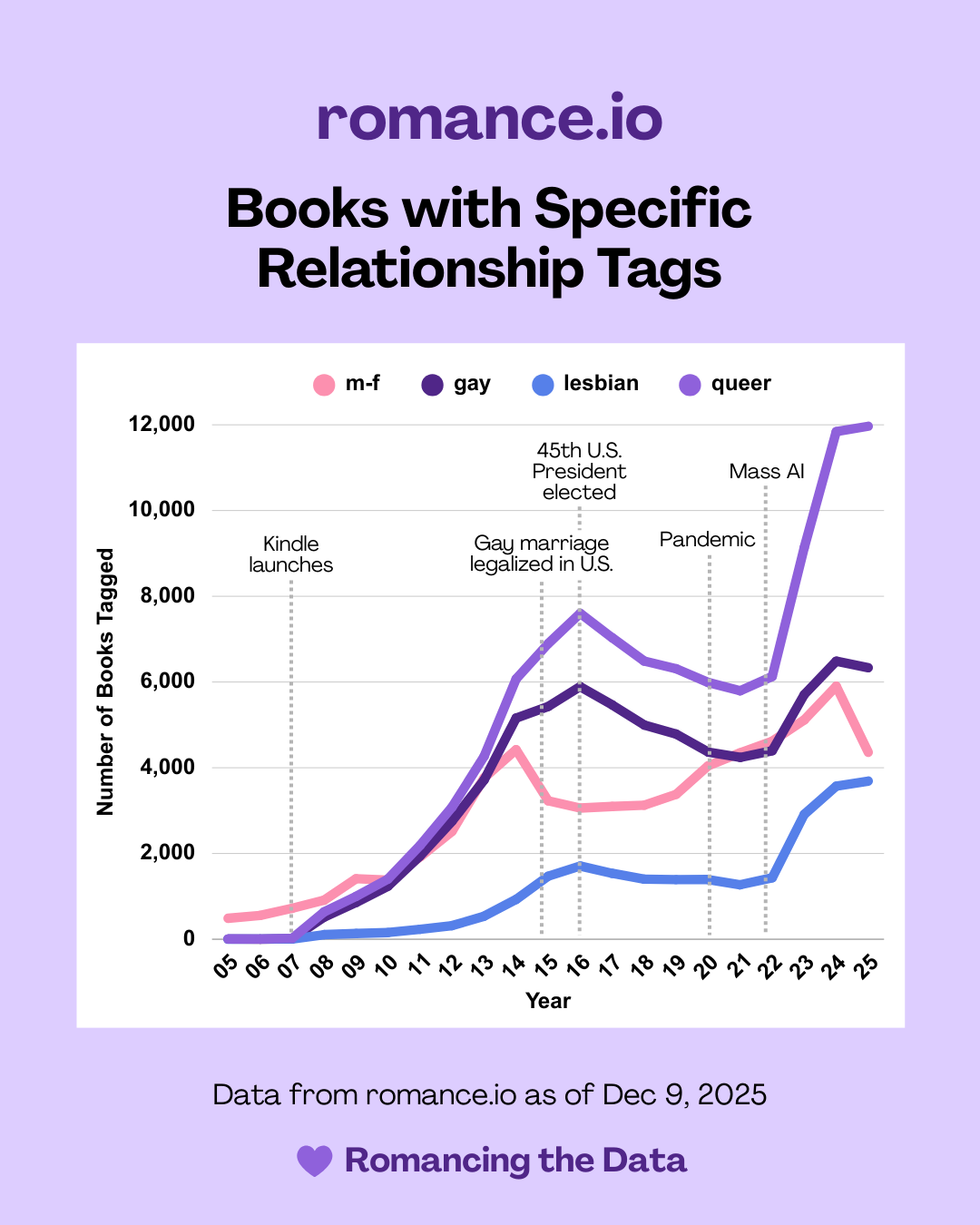
We see a fair bit more variation in this line graph compared to the Amazon Kindle Store graph. It’s interesting to look at the growth trends and see how they align with significant world events:
2007: Amazon releases the first Kindle > LGBTQ+ tags trend up
2015: Gay marriage is legalized in the United States > LGBTQ+ tags trend up
2016: Republican Donald Trump is elected president in the U.S. > LGBTQ+ tags trend down
2020: The pandemic officially begins > LGBTQ+ tags trend down (generally true across publishing)
2022: Public release of ChatGPT - era of mass AI > LGBTQ+ tags trend up
REMINDER: The data doesn’t indicate that these events caused the changes in LGBTQ+ tags.
In 2025 (as of December 9, 2025), the breakdown of LGBTQ+ tags is as follows:
queer romance - 11,966 books
gay romance - 6,332 books
m-f romance - 4,362 books
lesbian romance - 3,689 books
Queer is a broad term that can include a number of aspects of sexuality, so it’s not too surprising that it surpasses the gay and lesbian tags.
Learn More
If you’re looking to learn more about the history of queer romance, I recommend listening to this episode of the Shelf Love Podcast: Queer Romance: A History with Lucy Hargrave.
Happy reading! If you have any questions, let me know in the comments!
Same-sex marriage was legalized nationwide in the U.S. on June 26, 2015, by the Supreme Court’s landmark ruling in Obergefell v. Hodges.