

I’ve now completed 6 months (July to December 2025) of analysis on the Amazon Kindle Store Top 100 Best Sellers in Romance (Paid) list—hooray! 🎉🎉🎉
I also went back and compiled data from January to June 2025 for some easy measures (i.e., ones that require little manual data collection!), so I could have a full year view.
Here is my analysis of:
Publishers
Price
Point of View (POV)
Publication Age
Some links in this post are affiliate links. If you make a purchase, I may earn a small commission.
1. Publishers
If no recognizable publisher or imprint is listed, books are assumed to be self-published.
Publisher Type
As you can see in the graph below, the percentage of Big Five published books among the Top 100 Best Sellers slowly began to increase over the year, with a dip in August/September, ending on a high of 31% in December—more than 3 times the 9% it started at in January.
As such, there was a drop in Self Published books on the list, down 38% from January to December this year (from 71% to 44%).
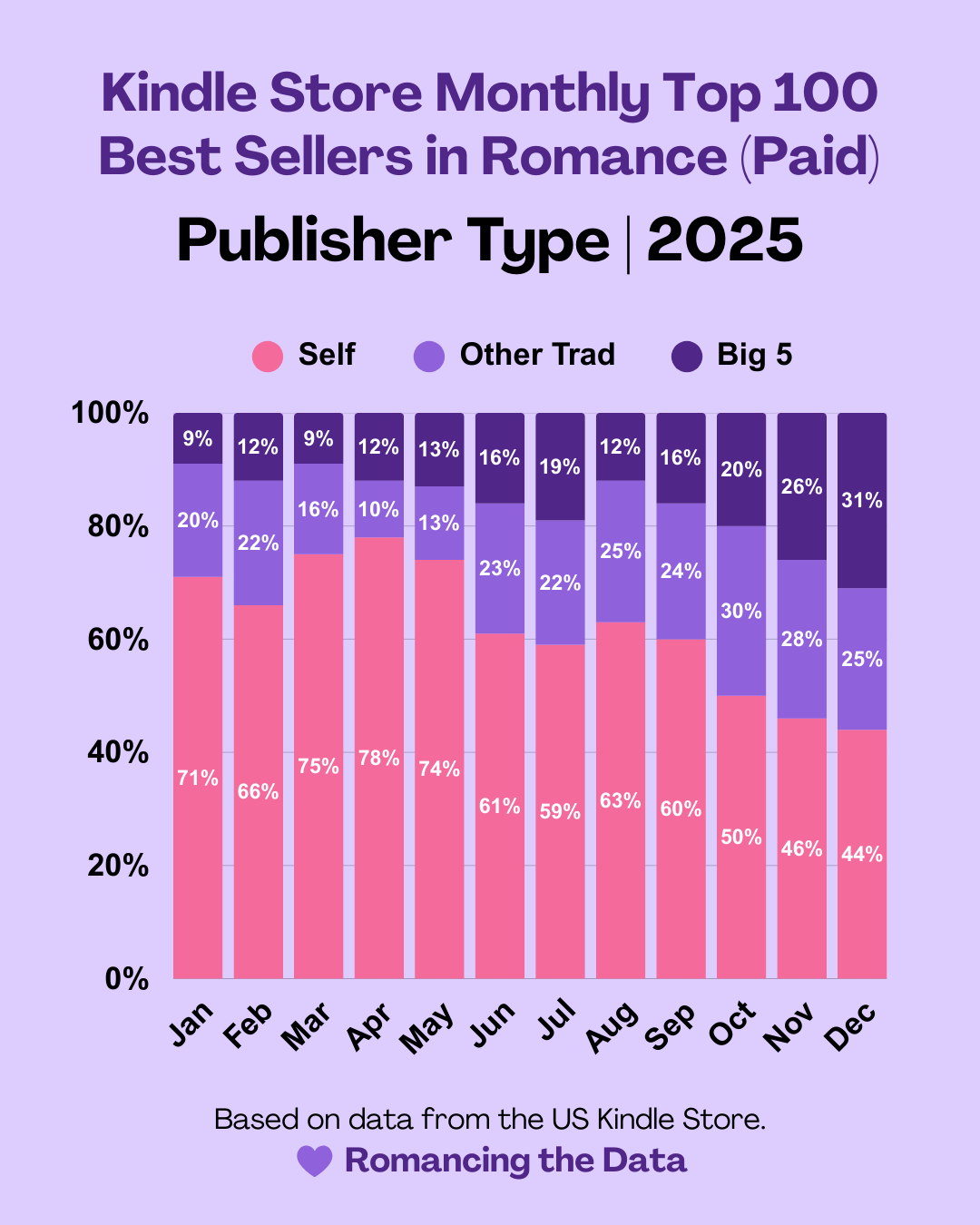
It’s possible this year-end increase in Big Five published books is seasonal—reflecting a slower period in traditional publishing for new releases in November and December, as well as the popularity of traditional best sellers during the holiday gift season.
The trend for Other Traditional published books was a bit less consistent throughout the year, but did increase 25% from January to December 2025 (from 20% to 25%). This category tends to be driven by a smaller number of tentpole authors like Sarah J. Maas and Rebecca Yarros. For example, the lows in April and May (10% and 13%, respectively) reflect when no Sarah J. Maas books appeared on the Top 100 (gasp!).
Traditional Publishers
Unique Books
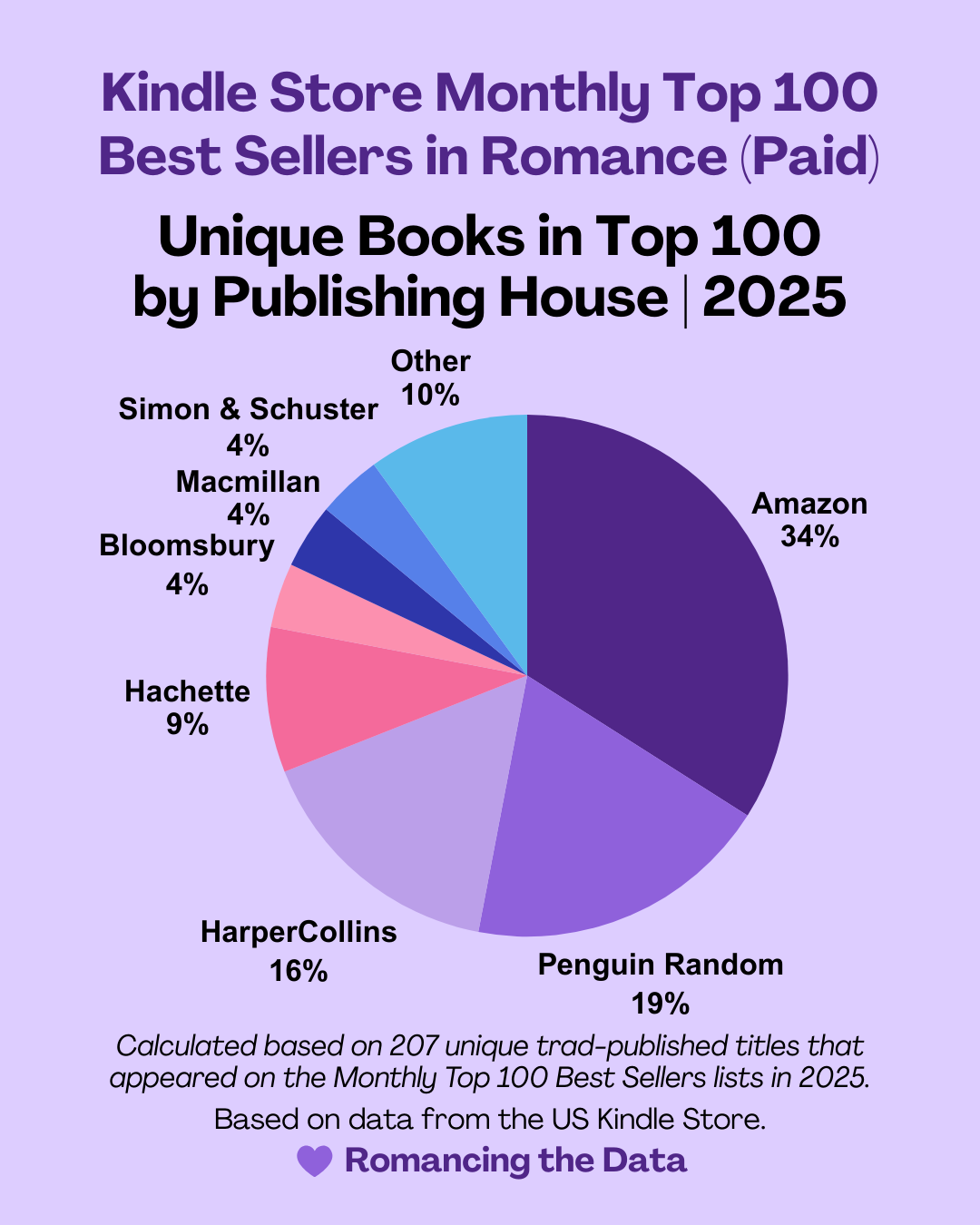
In total, there were 207 unique traditionally-published books on the 12 Monthly Top 100 Best Sellers in Romance lists in 2025. HarperCollins got a boost at the end of the year thanks to the success of the Heated Rivalry adaptation—I’m curious to see how long that continues into 2026. With the continued popularity of the show and announcement of Unrivaled, I think the series will have significant staying power.
Here is how those 207 unique books break down by publishing house:
Amazon - 34% (70 books)
Penguin Random House - 19% (39 books)
HarperCollins - 16% (32 books)
Hachette - 9% (19 books)
Macmillan - 4% (9 books)
Simon & Schuster - 4% (9 books)
Bloomsbury - 4% (8 books)
Other - 10% (21 books)
Entangled - 2% (5 books)
Kensington - 2% (5 books)
Zando - 2% (5 books)
Sourcebooks - 2% (4 books)
Evil Eye Concepts - 1% (1 book)
Tule - 1% (1 book)
Non-Unique Books
I also did a breakdown of the non-unique number of books (i.e., included duplicate titles that appeared in multiple months) by publishing house to account for books that had more staying power on the Monthly Top 100 Best Sellers in Romance list in 2025.
In total, there were 453 non-unique traditionally-published books on the 12 Monthly Top 100 Best Sellers in Romance lists in 2025
As you can see in the pie chart below, Amazon stays in the top spot, but the rest of the list changes a fair bit, with Hachette moving to second position and Bloomsbury and Entangled moving up the list as well:
Amazon - 32% (144 books)
Hachette - 14% (65 books)
Penguin Random House - 12% (55 books)
HarperCollins - 12% (54 books)
Bloomsbury - 10% (46 books)
Entangled - 8% (38 books)
Other - 12% (51 books)
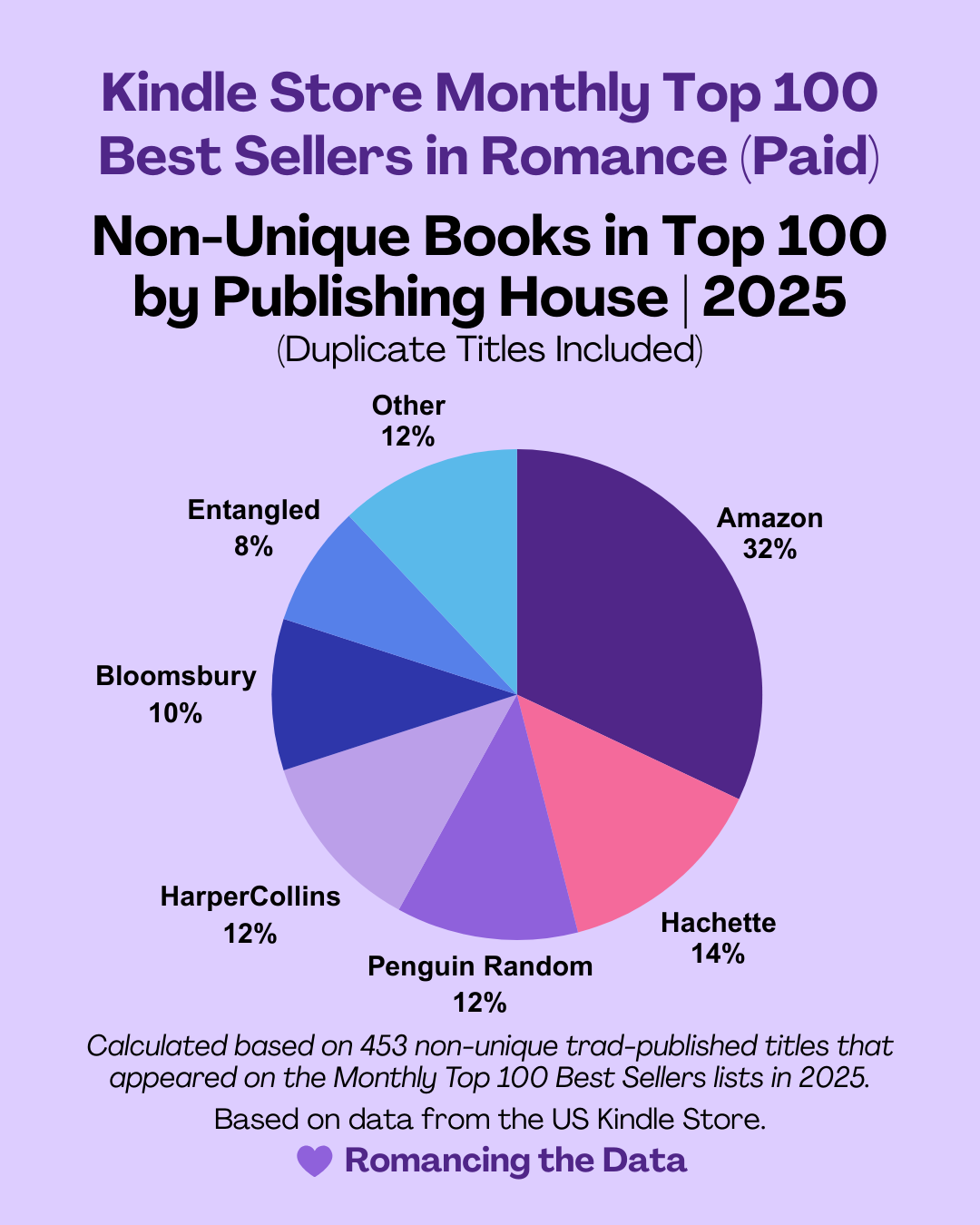
Based on these unique vs. non-unique breakdowns, we can conclude that Penguin Random House had more individual books on the Top 100 list, but Hachette’s books appeared on the list more times. For example:
Penguin Random House’s top ranking romance was Great Big Beautiful Life by Emily Henry, which appeared on the list for 5 months throughout the year.
Hachette’s top ranking romance was Quicksilver by Callie Hart, which appeared on the list for all 12 months of the year. Hachette also had 3 additional titles that appeared on the list for more than 5 months in the year (i.e., more than PRH’s top book).
Bloomsbury and Entangled are two “other traditional” publishers that have fewer books, but those books tend to appear on the Top 100 lists often so they also ranked higher in the non-unique book breakdown.
Amazon Growth
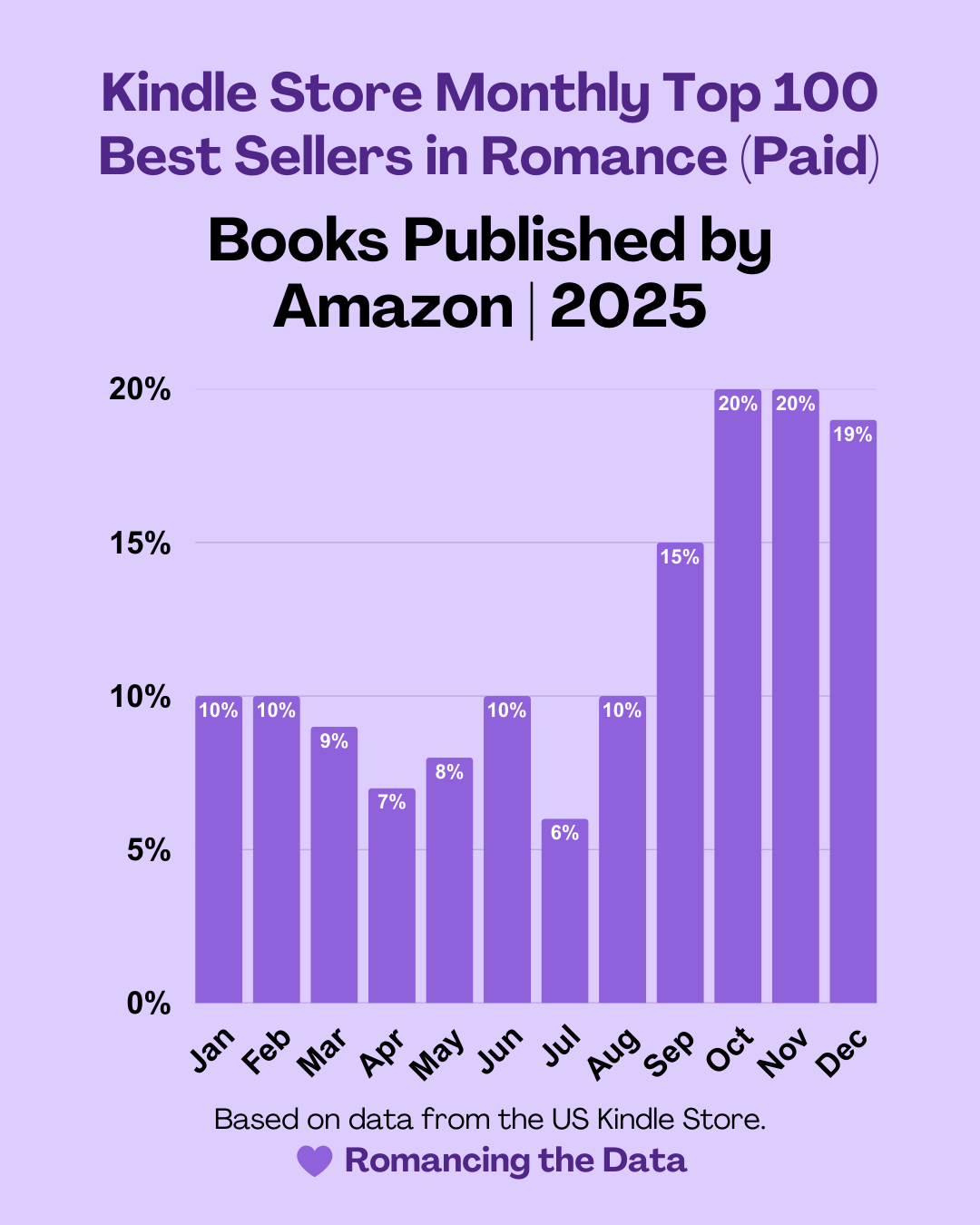
During 2025, Amazon steadily increasing its share of the Romance Top 100 list, going from a low of 6% in July up to 20% in October and November. It’s not too surprising that the publisher who owns the retail platform is doing well! It begs the question: how much of an advantage do books under Amazon’s imprints have on the platform?
However, Amazon-published books also appear to be locked out of The New York Times Best Sellers lists—none appeared on the The New York Times Combined Print & E-Book Fiction Best Sellers list in 2025.
Will this growth continue in 2026?
2. Price
Average Price
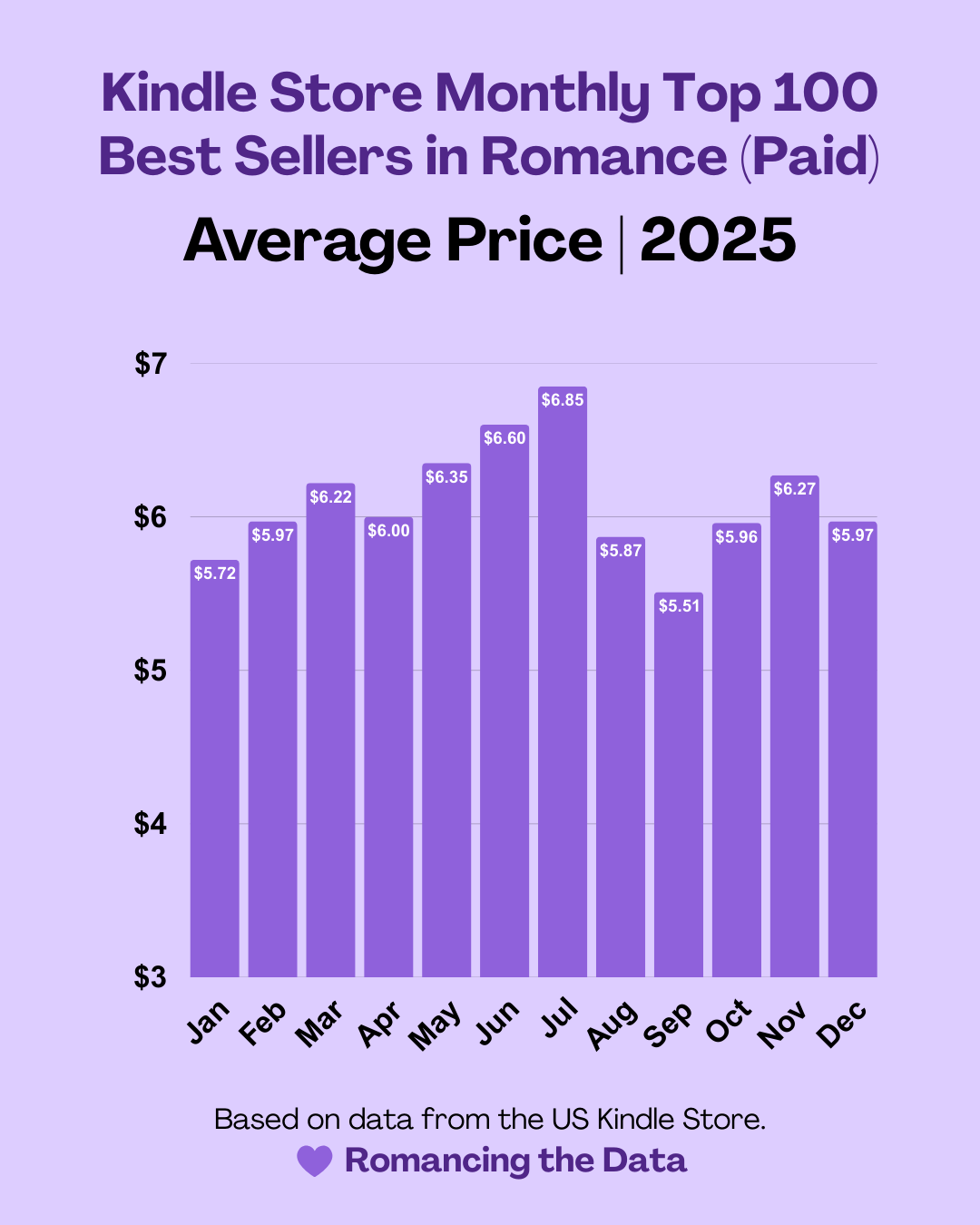
Over the year, the average price fluctuated between a low of $5.51 in September and high of $6.85 in July. The average of these 12 monthly averages is $6.11.
I don’t see an obvious pattern here, aside from a slight rise and fall that seems to happen every 3-4 months.
Kindle Unlimited
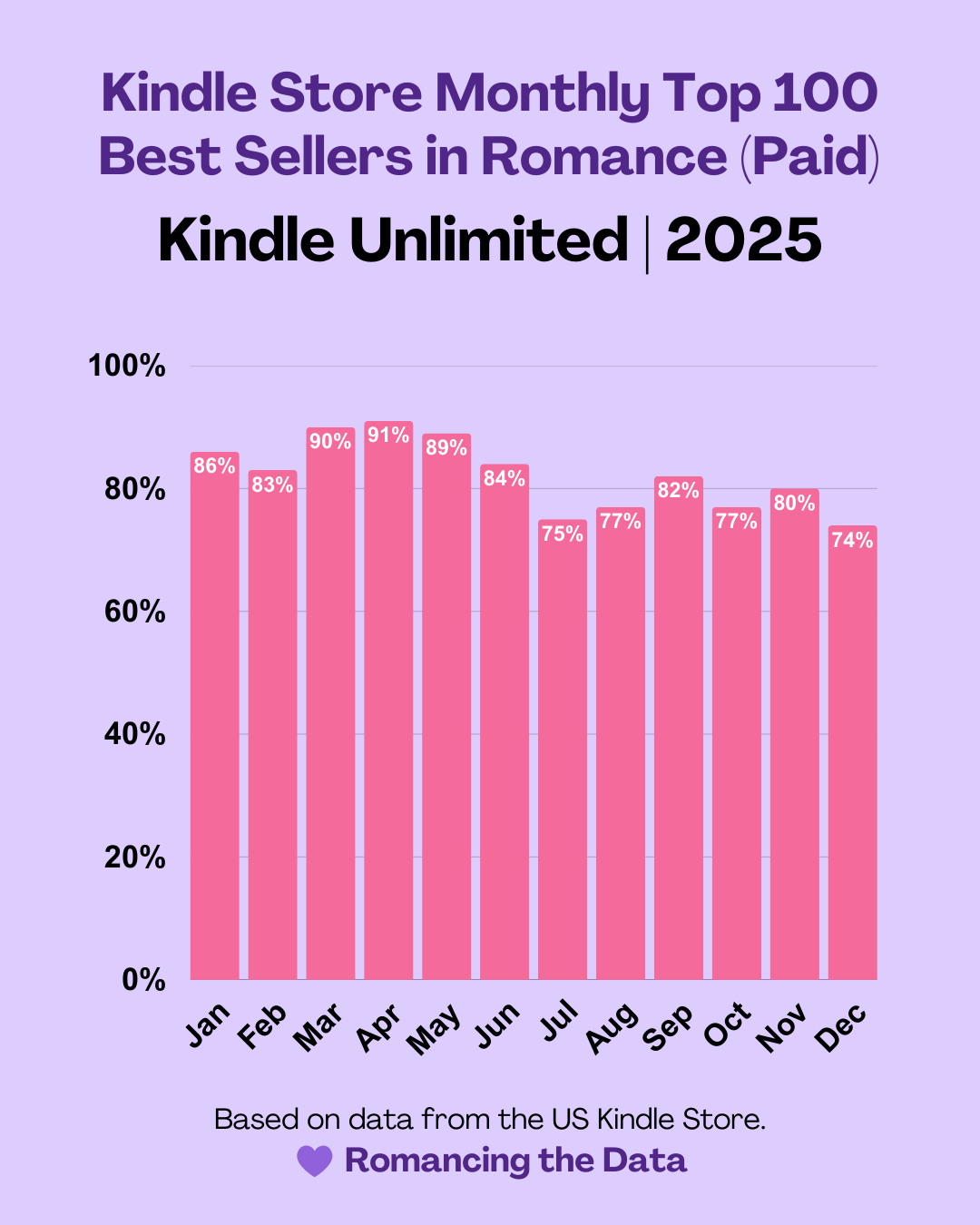
Looking at books available as part of Amazon’s Kindle Unlimited subscription service (KU), we see a general trends downward over the year, ending with a low of 74% in December—a 19% decrease from the high of 91% in April.
This downward trends aligns with the upward trend in Big Five-published books among romance best sellers (as seen in the very first graph in this post), which are less likely to be in KU.
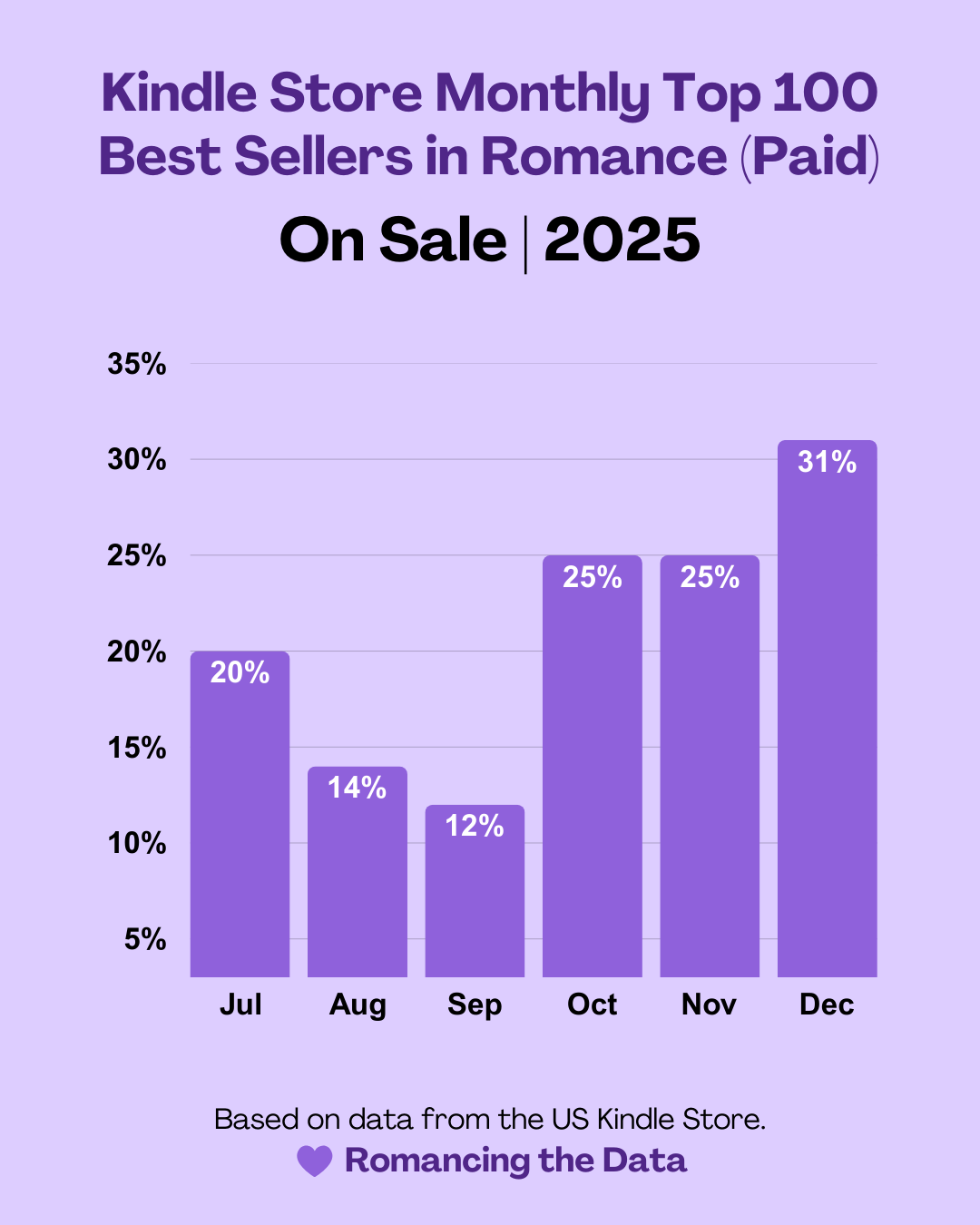
I only have data for the last six months of the year in terms of how many best sellers were on sale, but based on the graph below we see more of the romance best sellers were on sale in Q4 of 2025. Not surprising, as this aligns with retail sales period of Black Friday and holiday shopping.
3. Point of View (POV)
Book POV determined manually.
As you can see in the graph below, there has been a fairly steady increase in the number of third person POV books among the Top 100 Best Sellers in Romance throughout 2025—increasing from a low of 6% in March to a high of 27% in December (a 350% increase).
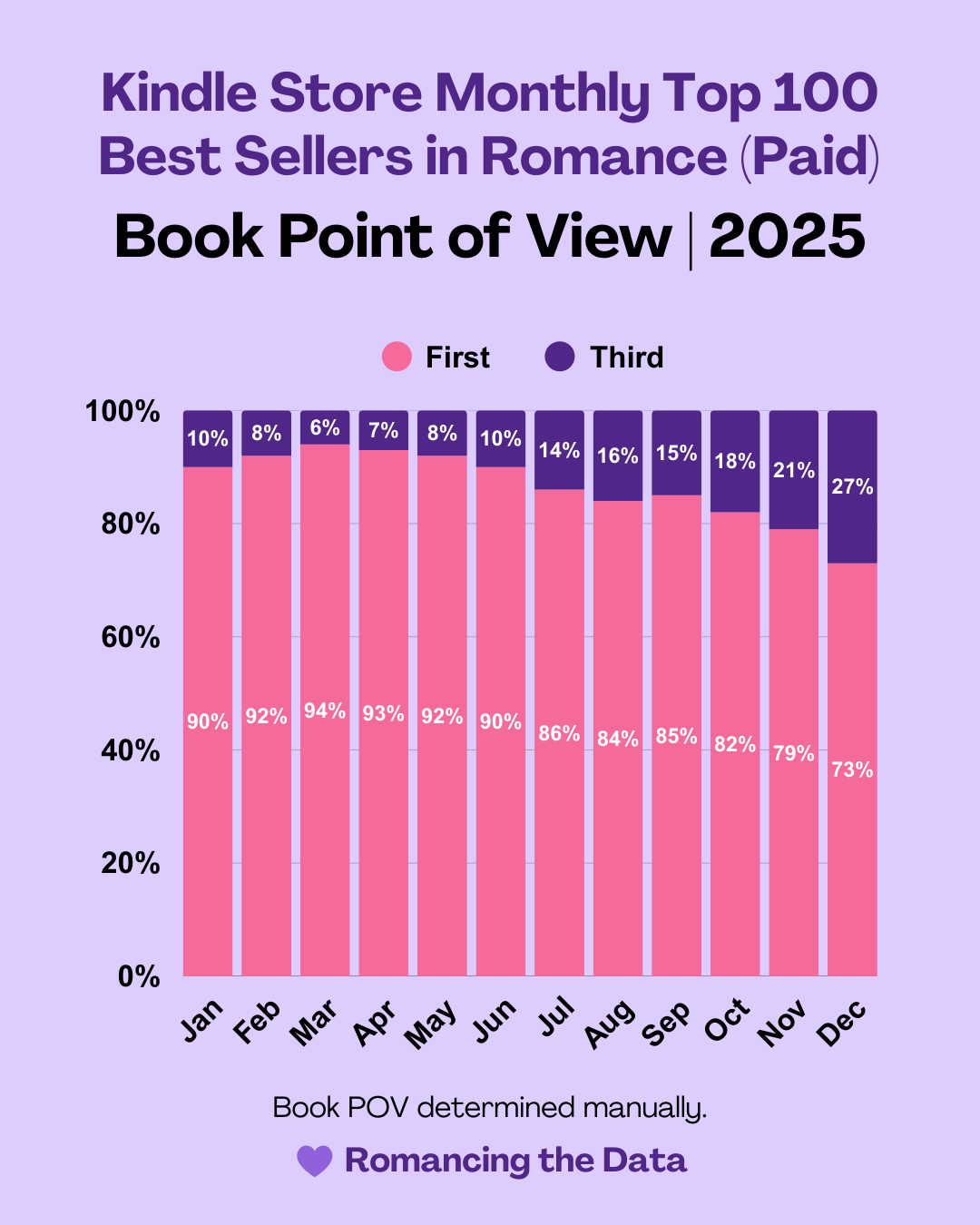
Some of this increase can be attributed to the popularity of Heated Rivalry, based on Rachel’s Reid’s Game Changers series, which is written in third person—especially in December when all six books appeared in the Top 100.
However, there are a number of other romance and romantasy authors that consistently appear in the Top 100 and write in third person. For example:
Romance: Nora Roberts, Laurie Gilmore, Catherine Coulter, Uzma Jalaluddin (and sometimes Christina Lauren)
Romantasy: Kaylie Smith, Lindsay Straube, SenLinYu (and sometimes Sarah J. Maas)
Reminder: we can’t say the books in the Top 100 are best sellers BECAUSE they are written in first person (there are too many factors to determine causation).
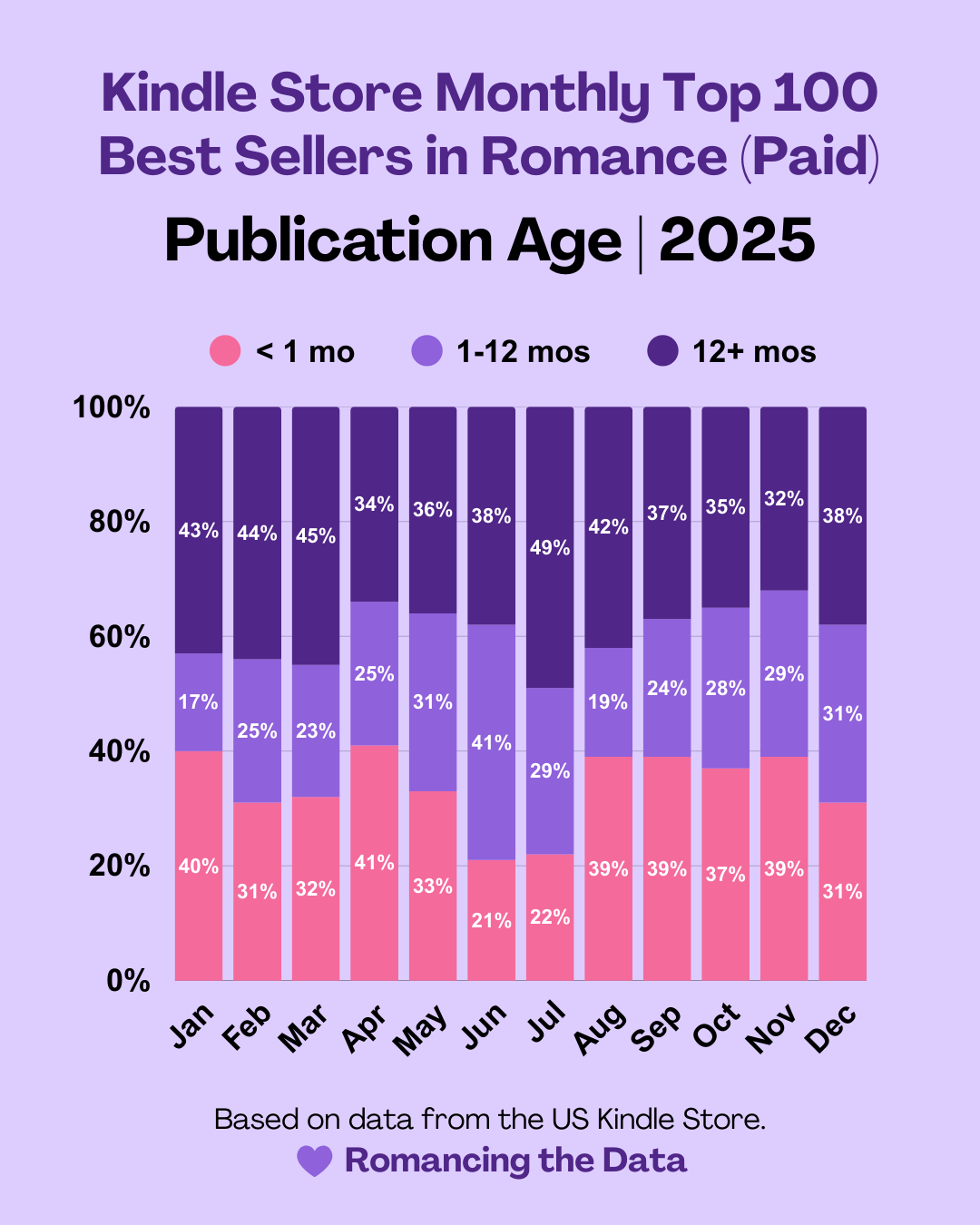
4. Publication Age
Frontlist = Published in the last year
Backlist = Published more than a year ago
Based on Amazon publication date, which doesn’t always align with the original publication date.
In the bar graph below, you can see that backlist books were more prominent in Q1 and the summer months (July and August) of 2025. This is likely a seasonal trend driven by traditional publishing schedules.
With a full year of data, there does appear to be a regular fluctuation pattern for the publication age of romance best sellers with a peak and valley roughly every 5 months; however, it is more muted in Q1. You can see the peaks for frontlist titles in April/May and October/November, along with the valleys in February/March and July.
Happy reading! If there’s anything else you’d like to see in this analysis, let me know in the comments!