


How many books appear on the The New York Times Combined Print & E-Book Fiction Best Sellers each year? How many authors?
I’m answering these questions and more in this next installment of my NYT 15-Year Analysis series, which highlights findings from my research on the 15 years of data available since the The New York Times Combined Print & E-Book Fiction Best Sellers launched in 2011.
Some posts in the series will be free, but you’ll need to become a paid subscriber to access all the findings (only US$5/month or US$50/year).
Data Source
List: The New York Times Combined Print & E-Book Fiction Best Sellers1
Sales Period: 2011 to 2025
Methodology: I compiled and analyzed the data to determine the number of unique books and authors that appeared on the list each year during this 15-year time period.
Number of Unique Books
An average of 242 unique books appear on the list each year.
As you can see in the graph below, the annual number hit a high of 303 books in 2014 and a low of 175 books in 2023—a 42% decrease over 9 years (128 fewer books).
It seems very likely that the pandemic (which started in early 2020) had an impact on this number; however, a decrease had already started in 2017.
The number of books per year was the lowest from 2022 to 2024, but has made a substantial jump in 2025, increasing 28% in just one year (from 190 to 243 books).
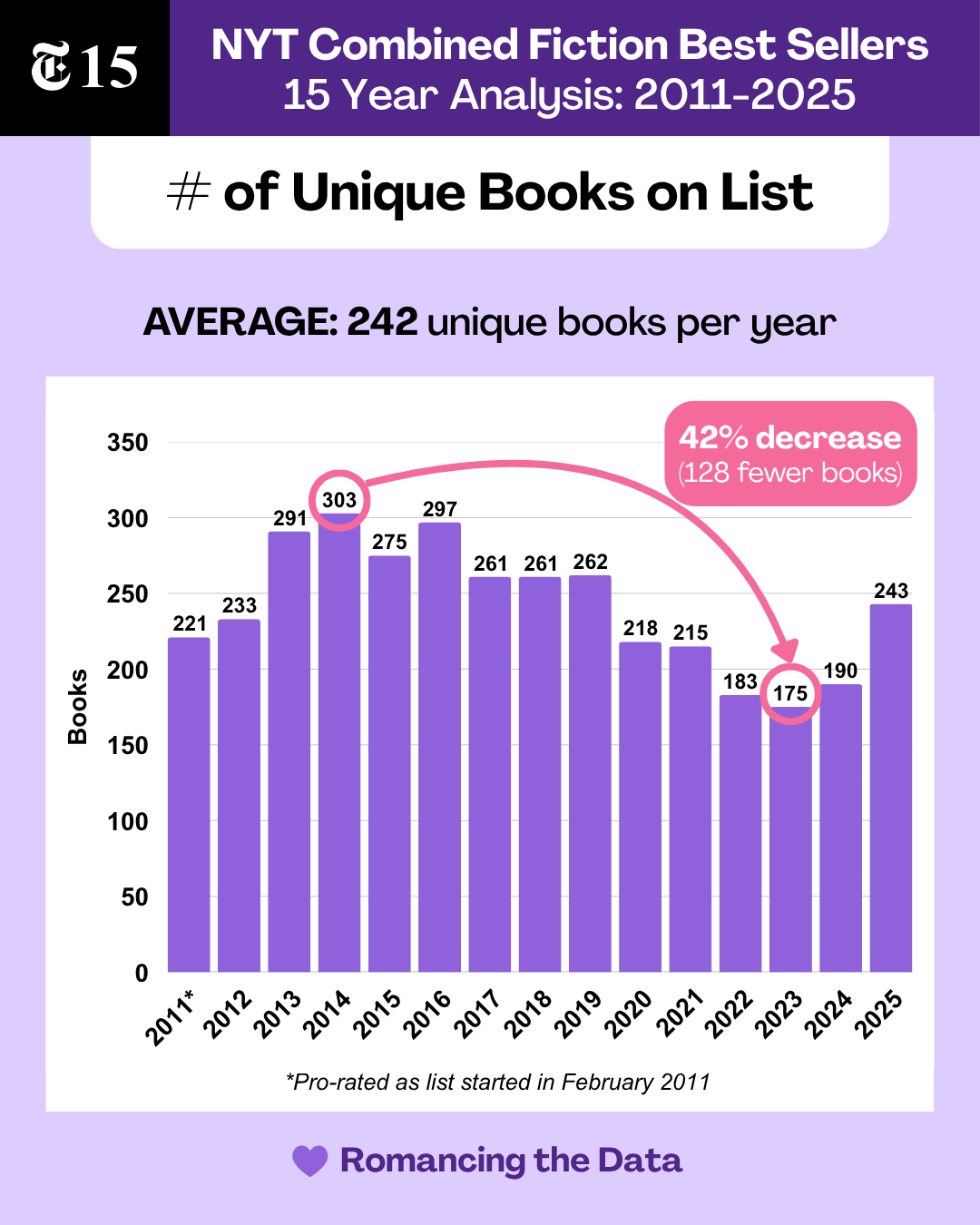
Number of Unique Books on the List
2011*: 221 books
2012: 233 books
2013: 291 books
2014: 303 books
2015: 275 books
2016: 297 books
2017: 261 books
2018: 261 books
2019: 262 books
2020: 218 books
2021: 215 books
2022: 183 books
2023: 175 books
2024: 190 books
2025: 243 books
*Pro-rated as list started in February 2011
Number of Unique Authors
An average of 179 unique authors appear on the list each year.
Similar to the unique number of books, the number of unique authors hit a high of 209 authors in 2014 and a low of 135 authors in 2023—a 35% decrease over 9 years (74 fewer authors).
The number of authors was the lowest from 2022 to 2024, but has made a substantial jump in 2025, increasing 25% in just one year (from 147 to 184 authors).
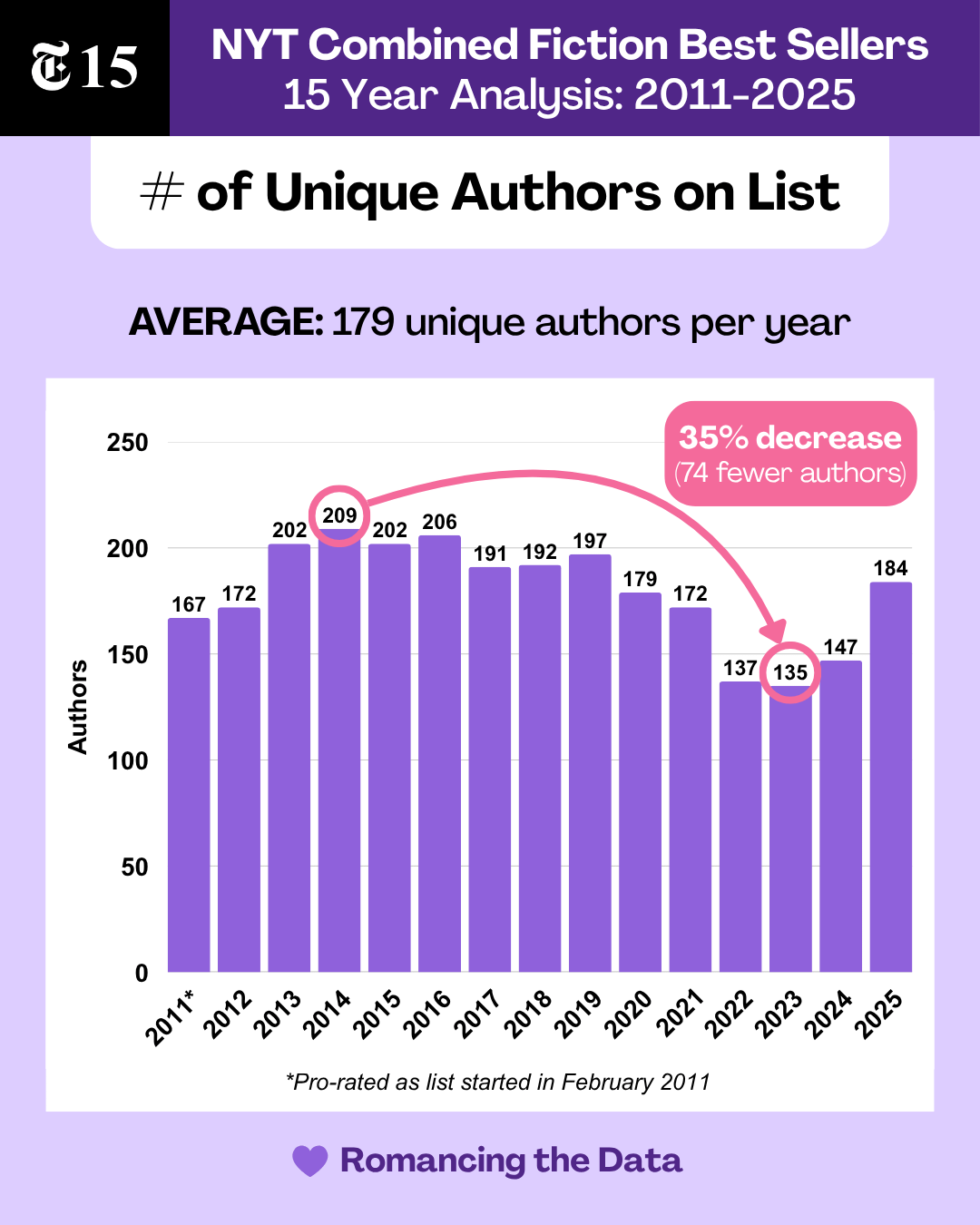
Number of Unique Authors on the List
2011*: 167 authors
2012: 172 authors
2013: 202 authors
2014: 209 authors
2015: 202 authors
2016: 206 authors
2017: 191 authors
2018: 192 authors
2019: 197 authors
2020: 179 authors
2021: 172 authors
2022: 137 authors
2023: 135 authors
2024: 147 authors
2025: 184 authors
Note: I counted various writing duos and groups as unique authors. For example, James Patterson has published books with several different co-authors, so books by each unique pairing were counted separately as a unique author.
*Pro-rated as list started in February 2011
Percentage of Unique Authors
The percentage of unique authors represents the level of author variation on the list—the lower the number means less variation, i.e., a smaller number of authors overall, meaning more authors with multiple books on the list.
Interestingly, the highest level of author variation was in the early pandemic years, 82% and 80% in 2020 and 2021, respectively. The lowest level was 69% in 2013, 2014, and 2016.
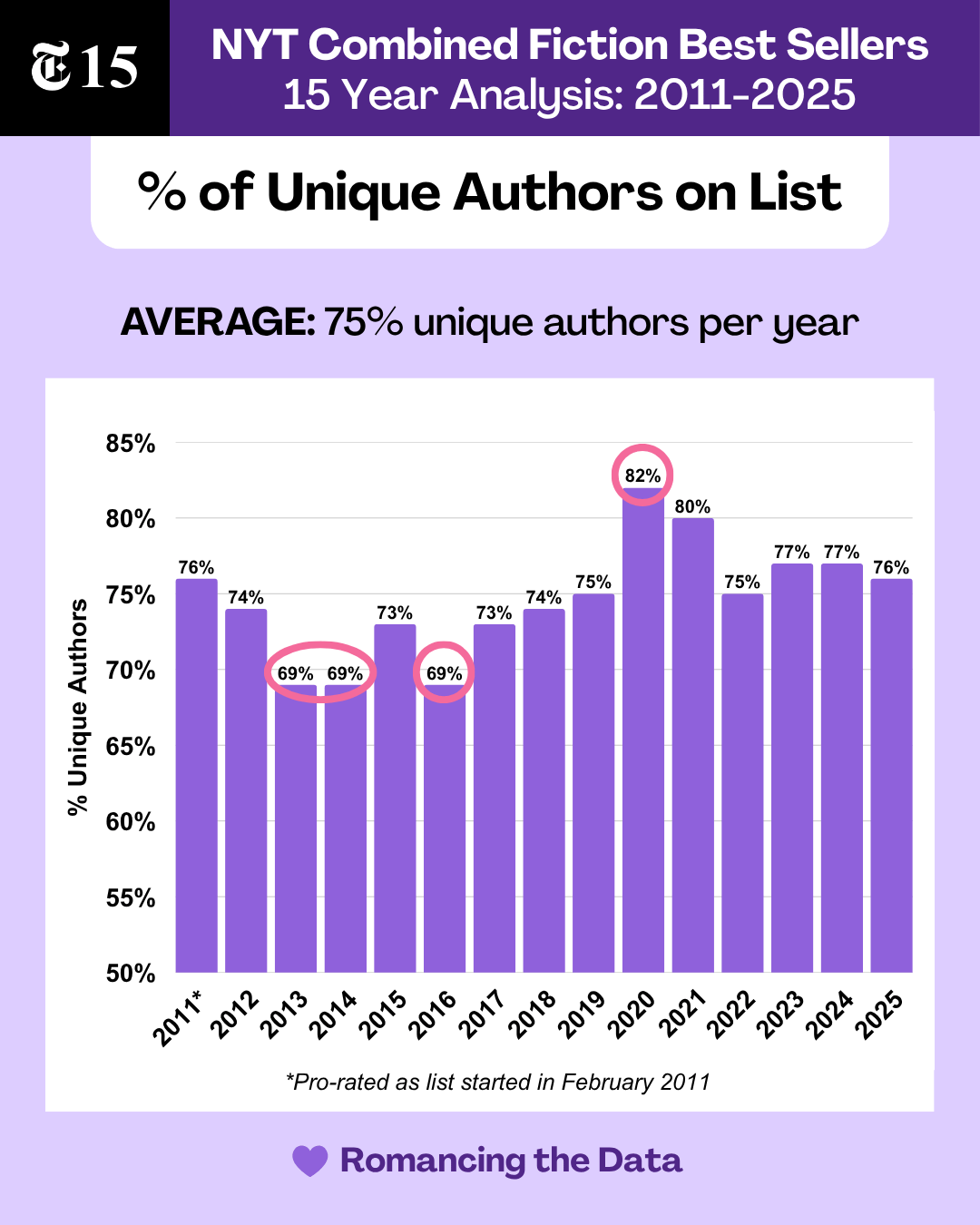
Percentage of Unique Authors on the List
2011*: 76% (167 authors of 221 books)
2012: 74% (172 authors of 233 books)
2013: 69% (202 authors of 291 books)
2014: 69% (209 authors of 303 books)
2015: 73% (202 authors of 275 books)
2016: 69% (206 authors of 297 books)
2017: 73% (191 authors of 261 books)
2018: 74% (192 authors of 261 books)
2019: 75% (197 authors of 262 books)
2020: 82% (179 authors of 218 books)
2021: 80% (172 authors of 215 books)
2022: 75% (137 authors of 183 books)
2023: 77% (135 authors of 175 books)
2024: 77% (147 authors of 190 books)
2025: 76% (184 authors of 243 books)
*Pro-rated as list started in February 2011
2013 vs 2020
Check out this comparison:
In 2013, 25 authors had 3 or more unique books on the list
In 2020, only 6 authors had 3 or more unique books on the list.
In 2013, a number of romance authors started appearing on the list for the first time with multiples titles, often from the same series. A few of these authors/books were also self-published.
For example:
Abbi Glines: 5 books from the Too Far and Perfection series (primarily self-published)
Christina Lauren: 5 books from the Beautiful series
H. M. Ward: 5 books, including installments from the Damaged and The Arrangement series (self-published)
J. Kenner: 3 books from the Stark series
J. C. Reed: 3 books from the Surrender Your Love series (self-published)
Katy Evans: 3 books from the Real series
Kyra Davis: 3 books from the Just One Night series
This increase in authors with multiples titles on the list helps explain the lower level of author variation in 2013.
I will be doing further publisher analysis, but it’s interesting to note that purely self-published books only appear on the The New York Times Combined Print & E-Book Fiction Best Sellers list until 2020. By “purely self-published”, I mean that the author’s name (or company) is listed as the publisher. Now self-published authors only seem to appear on the list when they work with a traditional publisher for print distribution.
In 2020, the pandemic started and it appears that a lot of authors who regularly had multiples titles on the list in a year were not able to achieve the same.
The 6 authors who managed to have 3 or more unique books on the list in 2020 are:
Christine Feehan: 6 books
Danielle Steel: 6 books
Stuart Woods: 5 books
Julia Quinn: 4 books (mostly backlist, thanks to Bridgerton!)
David Baldacci: 3 books
John Grisham: 3 books
This dramatic decrease in the number of authors with multiples titles on the list helps explain the higher level of author variation in 2020.
Most Books in One Year
Which authors have had the most books on the list in one year?
It’s a three-way tie between:
Nora Roberts: 9 books in 2016
Colleen Hover: 9 books in 2022
Freida McFadden: 9 books in 2025
Stay tuned for more from the NYT15 series! Next I’ll be looking at trends in the average number of weeks on the list over the years.
The New York Times introduced the Combined Print & E-Book Fiction Best Sellers list in February 2011 as part of a revamp to its bestseller lists. The changes were a response to the increasing popularity of ebooks and the need to reflect their sales in the rankings.
I love this data!
This is so interesting! Thank you for putting it altogether, that has to be a lot of work.